

The transformative scientific impact of Gerd Faltings and Abel Prize laureates, including Endre Szemerédi and László Lovász.
A mathematical proof is a gift for the future to unwrap” – according to the timeless saying. Although its origin is unknown, it appears as a standalone frame in the image film of the Abel Prize, often referred to as the Nobel Prize of mathematics.
The recipient of this year’s prize – officially the Niels Henrik Abel Memorial Prize, awarded since 2003 – is Gerd Faltings, a researcher at the Max Planck Institute for Mathematics in Bonn, “for introducing powerful tools in arithmetic geometry and resolving long-standing Diophantine conjectures of Mordell and Lang.” These are historic mathematical riddles, as described by the Norwegian Academy of Science and Letters in its official statement on this year’s Abel Prize, which portrays Faltings as a defining figure in arithmetic geometry – now an emeritus professor of the Max Planck Institute.
"His ideas and results have reshaped the field. Not only did he settle major long-standing conjectures, but he also established new frameworks that have guided decades of subsequent work. His exceptional achievements unite geometric and arithmetic perspectives and exemplify the power of deep structural insight” – says the Norwegian Academy's official statement.
The Diophantine problem known as the Mordell conjecture (1922) occupied mathematicians for 60 years. 
It asserts that a broad class of equations can have only finitely many rational solutions. Gerd Faltings did not originally set out to prove the conjecture; rather, he hoped his research would lead to something interesting. However, when in 1983, at the age of 29, he unexpectedly solved this long-standing open problem, he became world-famous overnight and went on to receive the Fields Medal in 1986.
His proof astonished experts, and from then on the Mordell conjecture became known as Faltings's theorem. In the decades that followed, Faltings solved one problem after another, as if stringing mathematical pearls onto a necklace.
| Diophantine equations One of the oldest and most central parts of mathematics is solving equations using only integers (a whole number which is either positive, negative or zero). These problems are called diophantine equations. One example is given by the Pythagorean theorem (x²+y²=z²). This equation has infinitely many solutions that are integers. Two simple examples are 3²+4²=5², or 9+16=25, and 52 + 122 = 132, or 25 + 144 = 169. Diophantine equations are at the core of Gerd Faltings’ work within arithmetic geometry. |
This is confirmed and further explained by Gergely Zábrádi, a researcher in the Analytic Number Theory and Representation Theory group at Alfréd Rényi Institute of Mathematics. His work partly lies in an area that grew out of one of Gerd Faltings’s theorems (Hodge theory).
He confirms that Faltings’s results opened up entirely new fields in theoretical mathematics; in fact, it can even be said that, in the long run, this new area may have connections to theoretical physics. Zábrádi has also met Faltings in person on several occasions. In 2009, he was a postdoctoral researcher in Bonn, where he regularly spent time with the professor, who at the time was serving as the institute’s director.
Mordell conjecture (1922), Faltings's theorem (1983) Related concepts: An algebraic plane curve is the set of zeros of a polynomial in two variables. For example, is a polynomial in two variables, and its zeros form a parabola. The degree of the curve is the degree of this polynomial; in the case of the parabola, the degree is 2. “Over the field of rational numbers” means that the coefficients of the polynomial are rational numbers. An algebraic plane curve is smooth if it has a unique tangent at every point. This means that at any point, at least one of the partial derivatives of the defining polynomial is nonzero. For instance, the parabola above is smooth everywhere, while the curve defined by is not smooth at the origin. In fact, one must require smoothness in the projective plane as well—that is, also at the “points at infinity.” For example, Fermat's Last Theorem (i.e. ) also defines an algebraic plane curve. Consider the curve given by the polynomial . For every , this is a smooth algebraic plane curve. If , we can apply Faltings's theorem: there are only finitely many rational pairs such that . If is a solution of the Fermat equation with , then setting and gives a rational point on the curve. By Faltings’s theorem, there can be only finitely many such rational pairs. Of course, since the 1993 result of Andrew Wiles, we know that the Fermat equation has no nontrivial solutions. The trivial solutions correspond to the points and . There are no other rational points on this curve (so there are exactly two, which is finite). (Text in this framework: Gergely Zábrádi ) |
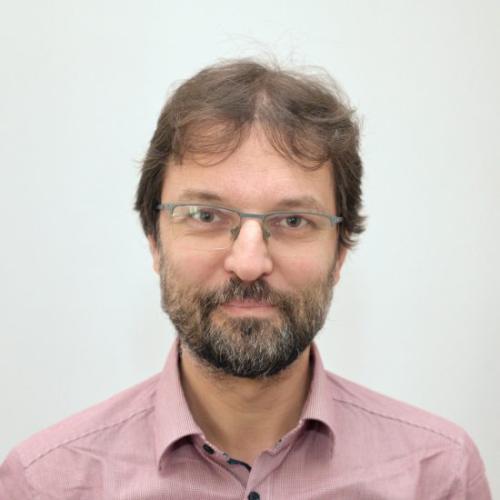
Gerd Faltings regularly made time for younger colleagues, attended every seminar, and often had lunch with them. “Fermat's Last Theorem had remained unsolved for a very long time – since the 17th century – and it was not known whether it had any solutions in nonzero integers. What follows from Mordell conjecture is that even if solutions exist, there can only be finitely many. Mordell’s result is more general: it applies not only to the Fermat equation but to many other equations as well, stating that they can have only finitely many solutions, if any at all. It was only about ten years later that it turned out that Fermat’s equation actually had no solutions. But in 1983, this was not yet known. This is why it was such a sensation in number theory – because finding the ‘solution’ to Fermat’s conjecture was extremely difficult,” explains Gergely Zábrádi.
“On the one hand, he understood this very difficult mathematics; on the other, he had original ideas. His work opened up several new areas in mathematics,” adds the Rényi Institute researcher. These developments later gave rise to entirely new schools of thought, even though Gerd Faltings did not supervise many PhD students—yet those he did mentor have almost all become distinguished mathematicians. His way of thinking had a truly school-forming impact. At the same time, it took considerable confidence for a doctoral student to ask him to be their supervisor. He set the bar very high. Understanding Faltings’s proofs requires substantial prior knowledge,” explains Gergely Zábrádi. “Such proofs can run to 200–300 pages,” he continues, “and sometimes they are not even presented in a single paper, but rather in a series of articles devoted to the topic.”
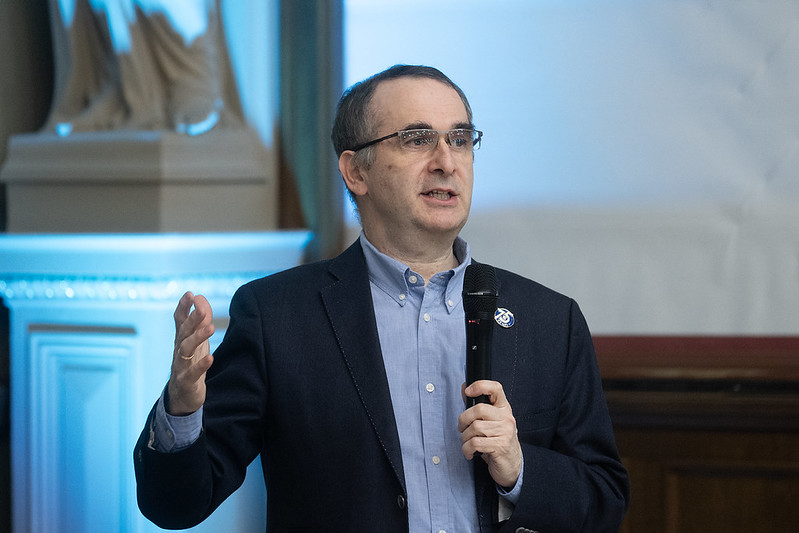
Gerd Faltings’s proof of the Mordell conjecture is not long – only about 20 pages.
“Mathematical results often unfold their impact over centuries or even millennia, and by the 21st century they completely permeate our everyday lives. Mathematics is also the foundation of basic research,” recalls András Stipsicz, member of the Hungarian Academy of Sciences and director general of Alfréd Rényi Institute of Mathematics. “In the 24 years since the prize was established, there have been 29 laureates, including three Hungarians – this reflects the strength of Hungarian mathematics,” he adds. (They are Peter Lax (2005), Endre Szemerédi (2012), and László Lovász (2021) – ed.)
“Two of the three laureates work in Hungary, at Alfréd Rényi Institute of Mathematics, in discrete mathematics, and their results are indispensable for the development of computers, for example, in establishing the theories needed for the efficiency and speed of algorithms. In the laudation for László Lovász, it is explicitly stated that ‘his contribution is fundamental to the development of computer science,’” recalls András Stipsicz. “The theorems they proved reshaped the way mathematicians think, and their impact has spread into the economy, engineering, and physics, transforming them in remarkable ways – for instance, the development of a medical device requires a vast mathematical foundation.”
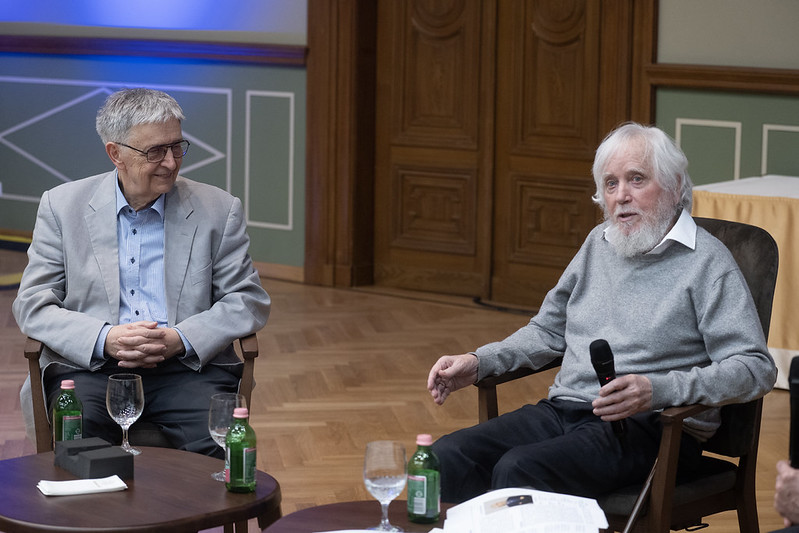
When looking at Abel Prize laureates not through their specific results but through their mathematical mindset, a broader common pattern emerges that applies to the work of Endre Szemerédi, László Lovász, and Gerd Faltings alike. One such shared aspect is the search for “deep structures”: laureates such as Jean-Pierre Serre, Gerd Faltings, or Andrew Wiles did not merely solve isolated problems, but uncovered hidden connections between seemingly unrelated phenomena.
It is also characteristic that Abel Prize results often arise at the intersection of multiple fields, i.e. algebra and geometry, analysis and physics, or number theory and topology.
Many Abel laureates spent decades working on a single problem or on building a theoretical framework. In the process, they did not simply arrive at solutions, but rather came to understand entire systems. They did not primarily provide answers; instead, they made it possible to ask new questions.