

XPRIZE Quantum Applications Competition Finalists Announced András Gilyén, a mathematician specializing in quantum computing at the HUN-REN Alfréd Rényi Institute of Mathematics, and his research team have made it into the top 7 finalists of the XPRIZE Quantum Applications competition. The XPRIZE Quantum Applications challenge called for the development of quantum algorithms that could have a positive impact on humanity in the foreseeable future—for example, by solving complex problems in healthcare, climate, energy, and materials science. The competition attracted 133 teams from 31 countries. Twenty semifinalists were selected, and joining the Hungarian team in the finals are three research groups from the United States and one team each from Canada, the United Kingdom, and Switzerland.
"These 7 teams demonstrate the potential to pioneer quantum algorithms that can outperform classical computers and solve real-world problems. Finalists were selected by an independent and renowned, cross-sectoral panel of quantum and domain experts, and announced during Q2B Silicon Valley. They will share a 1 million USD prize at this stage, with an additional 4 million USD to be awarded in March 2027, including 3 million USD for a grand prize winner," announced Google and the XPRIZE Foundation, whose global challenge is supported by Google Quantum AI, Google.org, and GESDA (Geneva Science and Diplomacy Anticipator). We asked András Gilyén about their entry and the competition. He says he had been familiar with this global competition before.
"The XPRIZE Foundation's fundamental goal is to use its challenges to encourage researchers to find new solutions to the world's important problems. They've had dozens of challenges already. I first noticed the 2007 Google Lunar XPRIZE, which aimed to inspire the private sector to land a functioning device on the Moon without using any government funding or assistance from space agencies. I followed a Hungarian participant, Puli Space, interested in their progress with the lunar rover they were developing. They achieved some success, but ultimately it proved too ambitious a challenge. There was no winner—no one has yet managed to send a device to the Moon using private capital alone—but it inspired many players, so in that sense it was still successful. More recently, most XPRIZE challenges have focused on carbon capture and other global problems. Then Google decided to get involved again and sponsor a new competition aimed at finding the most tangible and important application areas for quantum computers. Google is heavily invested in building its own quantum computer (Google Quantum AI), a serious investment they'd obviously like to see pay off. While competition in building quantum computers is fierce and everyone develops their technology in secret, the field of applications is still so open that collaboration is the goal. Google wants humanity's general knowledge to grow about what problems quantum computers will actually be efficient at solving—computers that Google or another company or research lab will eventually build. This might be surprising to a layperson: despite having a huge team working on it and putting in enormous effort, even Google doesn't clearly see what quantum computers will be practically useful for. However, it's broadly understood that quantum simulation—simulating materials and chemical processes—will be very useful, but no one has yet found a tangible, foreseeable, breakthrough 'killer' application. So with this challenge, Google is trying to get as many people as possible thinking about this," explains András Gilyén, providing an overview of the challenge and discussing what making the finals means for his "Gibbs Samplers" research team:
"For the XPRIZE quantum challenge, we put together a package describing what algorithmic approach we're using, what problem we're addressing, and what our end goal is. Specifically, we're testing and further developing randomized quantum sampling and state preparation algorithms that our team members have been developing for years. With these quantum Monte Carlo algorithms, we want to solve simulation problems that could help answer various materials science questions—for example, related to high-temperature superconductors. We submitted the first version, the jury selected 20 semifinalist teams based on that, and now we've made it to the finals. We'll have a year to continue working on this project. We'll receive feedback on where the weak points are, what they think needs more thorough development, whether the algorithm's real-world usefulness is clear, and what the actual resource requirements are for the entire process and our solution. So over the year, the applications we've been working on at a more theoretical level will become more tangible. A total of one million dollars in 'milestone prizes' will be distributed among the finalists in this round, which is significant support and inspiration for our 8-person team."
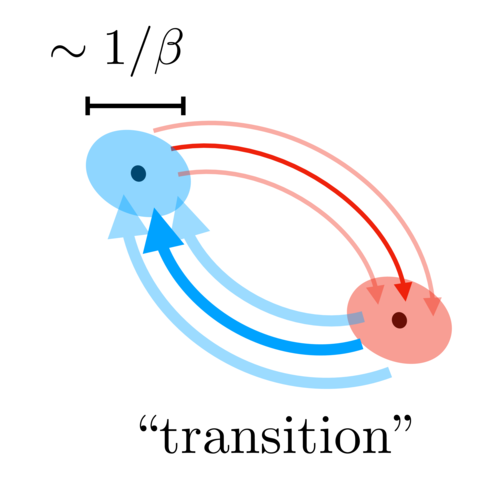
András Gilyén's video introducing his finalist team, "Gibbs Samplers," at the Q2B25 Silicon Valley conference can be viewed HERE
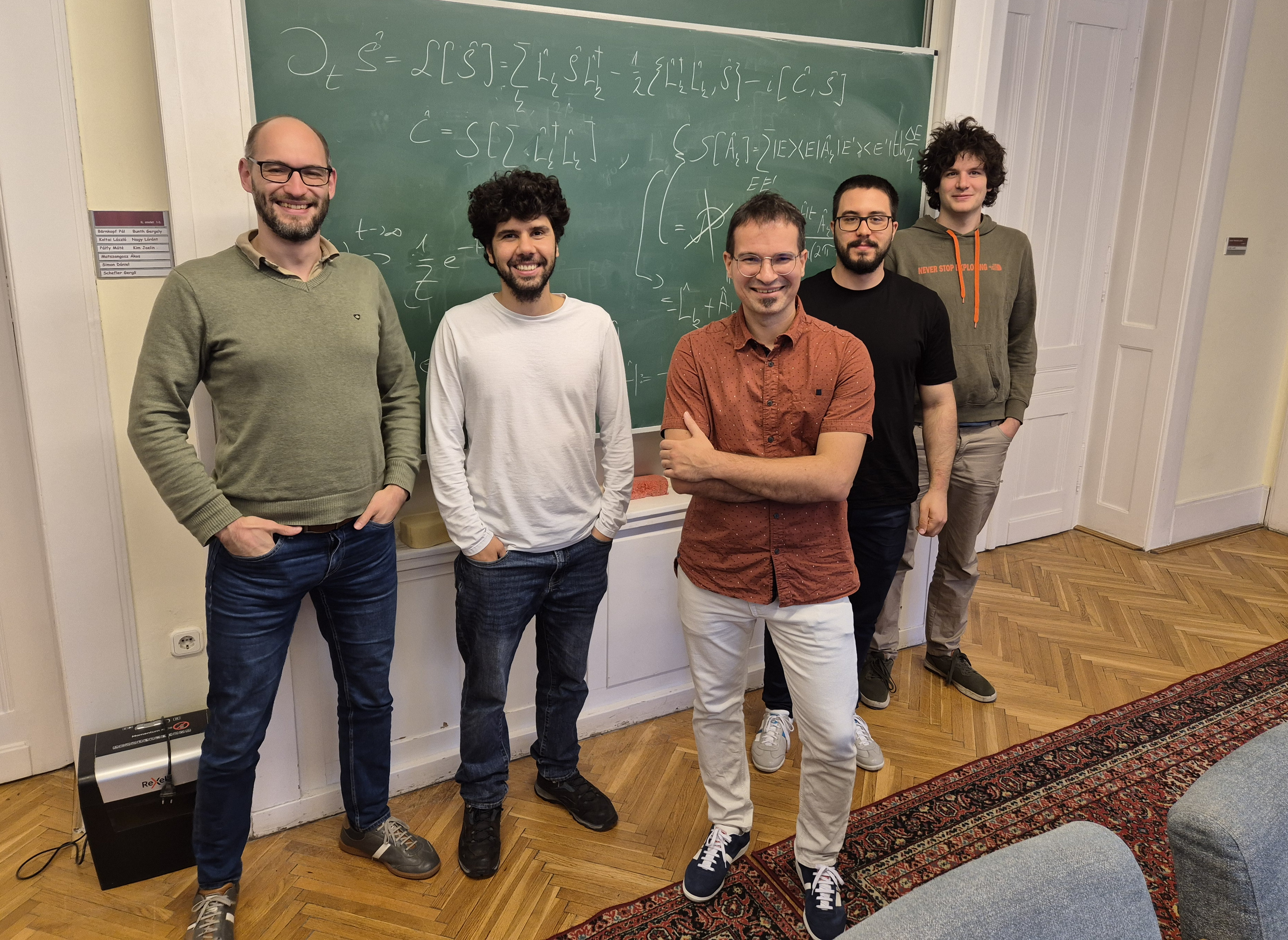
The members of the Gibbs Samplers team, from left to right: József Mák (HUN-REN Wigner Research Centre for Physics), João Doriguello (HUN-REN Alfréd Rényi Institute of Mathematics), András Gilyén, team leader (HUN-REN Alfréd Rényi Institute of Mathematics), Csaba Czabán (HUN-REN Alfréd Rényi Institute of Mathematics, Wigner Research Centre for Physics, ELTE IK), Balázs Kabella (HUN-REN Alfréd Rényi Institute of Mathematics, Wigner Research Centre for Physics, ELTE IK)
Foreign members also include Chi-Fang (Anthony) Chen (UC Berkeley), Michael J. Kastoryano (University of Copenhagen, AWS Center for Quantum Computing), Zoltán Zimborás (University of Helsinki, HUN-REN Wigner Research Centre for Physics)